

At the age of 80, Donald Trump has developed a potty mouth in public.
I admit—this is not a huge issue before the country, and it shouldn’t be. But it is something. Something telling about him, and about us.
And yes—I can hear the verdict already: Terry is clutching his pearls. Fetch your mink from the closet, buddy, adjust your necklace, and retire from the conversation.
I get it. I share the attitude. As a child of the 1970s and ’80s, I remember the horror of my parents’ generation at Prince, heavy metal, even Michael Jackson. I wrote about that cultural upheaval at the time for The New Republic (where I described Prince as “the master of the single entendre”).
I have no desire to become the old man who mistakes his discomfort with change for the decline of civilization. In fact, I value the power of the dirty word. (More on that later.)
I just think something is being lost here.
Trump has taken to cursing of a certain kind. It bursts from him, hot with contempt.
When Trump curses, it carries an invitation: enjoy this person’s humiliation with me. The political movement that hates together, wins together.
His supporters cheer, and the little ecstasy of voicing their hatreds does political work. They are primed, licensed, and liberated from the obligation to treat an opponent as someone worth hearing, or even as recognizing them as a legitimate American.

And so the MAGA faithful carry the performance online, into an argument, into an encounter with a stranger. Vulgarity becomes a weapon of the movement, and a badge of belonging. Restraint is for suckers. Cruelty proves you’re on the team.
But the presidency does not belong to the president. It belongs to us.
Its power comes partly from our history and traditions, from the generations who built the country and entrusted this office with their hopes and their civic decency. Whoever occupies it inherits unspoken obligations, including an obligation to speak with some awareness that he represents a people rough and vulgar in their ways, sure—but decent, and at their best aspiring to live up to the example of their forebears.
That sounds stuffy. But in practice, it describes something we all understand: holding a position of trust requires you, sometimes, to govern yourself.
Some people see Trump’s increasingly uninhibited speech as evidence of mental decline, a loss of inhibition control associated with dementia. I don’t know. Power, applause, and the steady disappearance of anyone willing to tell him no offer another explanation. Either way, we are entitled to more from a president.
But there is a deeper reason I dislike our potty-mouth presidency, and it may be the one I feel most strongly about.
The right curse word in the right place at the right time is right.
Sometimes it is the only word that will do. Pain, fury, astonishment, and even joy can demand it. We need that power when normal language falls short.
And that power can be squandered. When every little annoyance merits an obscenity, when every opponent gets the same excremental dismissal, curse words lose their power to change the weather of a conversation or a confrontation or an intense moment. The sorcery in them ebbs away. They become verbal packing material.
I value the power of swear words too much to see it drained, pouring from a president’s mouth just because he wants to exercise his hatreds in public, or because he knows it corrupts his audience, or because he is in mental decline.
I want a curse to mean something. So I’m willing to risk a little pearl clutching on behalf of the distinction between Trump’s cursing like a cheap hood and the strong use of a curse that meets the moment.
“Damn the torpedos, full speed ahead!”
Farragut shouted at the Battle of Mobile Bay.
“This is our fucking city! And nobody gonna dictate our freedom. Stay strong.”
David Ortiz spoke for every Bostonian—every proud and decent American—when he hollered that declaration into a live mic on a national TV broadcast of the Red Sox’s first home game in 2013, five days after the bombing of the Boston Marathon.
Click here for the moment:
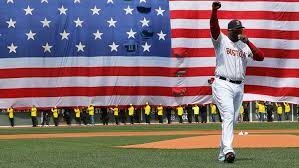
The FCC Chairman at the time, Julius Genachowski, publicly said Big Papi spoke from the heart and that he stood with him.
Our poem this week—a prose poem by Karl Shapiro—has shaped my feeling about swear words since I first read it in high school.
A boy experiences a dirty word as a captive vulture inside his mind: terrifying, fascinating, alive. He keeps returning to it, feeding it, tormenting it, enjoying its forbidden existence. Then something happens to the bird.
The Dirty Word
by Karl Shapiro
The dirty word hops in the cage of the mind like the Pondicherry vulture, stomping with its heavy claw on the sweet meat of the brain and tearing it with its vicious beak, ripping and chopping the flesh. Terrified, the small boy bears the big bird of the dirty word into the house, and, grunting, puffing, carries it up the stairs to his own room in the skull. Bits of black feather cling to his clothes and his hair as he locks the staring creature in the dark closet.
All day the small boy returns to the closet to examine and feed the bird, to caress and kick the bird, that now snaps and flaps its wings savagely whenever the door is opened. How the boy trembles and delights at the sight of the white excrement of the bird! How the bird leaps and rushes against the walls of the skull, trying to escape from the zoo of the vocabulary! How wildly snaps the sweet meat of the brain in its rage.
And the bird outlives the man, being freed at the mans death.
(But I one morning went upstairs and opened the door and entered the closet and found the great bird dead. Softly I wept it and softly removed it and softly buried the body of the bird in the hollyhock garden of the house I lived in twenty years before. And out of the worn black feathers of the wing I have made these pens to write these elegies, for I have outlived the bird, and I have murdered it in my early manhood).