Let’s get out of here. Let’s escape.
The times oppress us. The velocity of the news drives torrents of shock and anxiety and even despair into our days. It’s exhausting.
This is what happens when countries begin the slow—at first imperceptible, then incredible, and finally ineluctable—slide into existential struggles, crises of democracy, civil wars. I’ve seen it: Central America, the Balkans, Crimea, Libya, Eastern Ukraine.
We aren’t there yet, and I maintain a deep faith in the decency and common sense of most Americans. But who can deny that some gravitational pull in our poisoned politics is drawing us toward a place that our country has never been, except perhaps during the era of our own, horrible Civil War?
There have been other bad times in our history, of course. I remember some of them. Among my earliest memories are the assassinations of Martin Luther King Jr. and Robert Kennedy, 62 days apart in the spring and early summer of 1968.
Even as a child, I could feel the shock and bewilderment in my family. I could feel the fear. I’ll never forget my mother’s heartbroken cries as we learned of King’s murder, nor how my brother Jim, home from college and up late, roused the house with the terrible news that Bobby Kennedy had been killed in California. It felt like the country was coming apart.
But this era, our era, seems somehow more random, chaotic, and crazed. We live in a time of epistemic collapse—the destruction of a shared reality, the loss of a set of facts that we all recognize as both true and as the ground of our arguments. And that’s not an accident.
There has been a ferocious assault on truth from outside and from inside our country, from our enemies abroad who are weaponizing our ubiquitous technologies against us, and from our own president for whom the truth is merely an option, and for whom lies are almost always the preferable option.
In this state of affairs many people move as if sleeping, or dreaming, or maybe just pretending. “Your life gets smaller,” my friend and former colleague Tomek told me once, when I asked him what life was like in Poland during the illiberal rule of the country by the Law and Justice Party. I had no idea, really, what he meant; I do now.
And I get it: Who can blame them, the sleepers, the dreamers, the inhabiters of smaller lives? The desire to escape from our desperate politics is rational.
This is why it is so important to get out of our media-saturated days. We must find rest, the balm of hours not focused on our civic struggles.
Rory helps me. As many days of the week as I can, she and I are on the trails for an hour or so. There are moments when all that matters is the moment itself, which is the only real place, the place where Rory and all dogs always live, but where humans, with our worries and distractions, rarely visit.

And poetry helps.
This week’s poem is, I hope, its own balm. It’s by Wendell Berry, the great American poet, novelist and environmentalist. As I was thinking about selecting this poem for this week’s column, I read it aloud a few times; I’ve added a recording of one of those readings here, too.
—Terry
The Peace of Wild Things
by Wendell Berry
When despair for the world grows in me
and I wake in the night at the least sound
in fear of what my life and my children’s lives may be,
I go and lie down where the wood drake
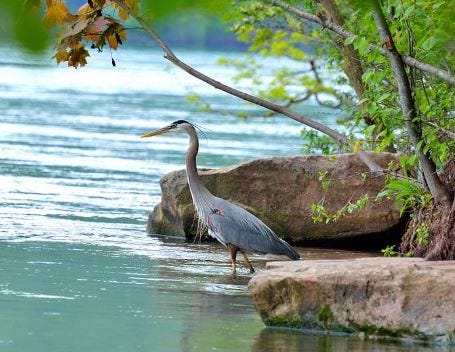
rests in his beauty on the water, and the great heron feeds.
I come into the peace of wild things
who do not tax their lives with forethought
of grief. I come into the presence of still water.
And I feel above me the day-blind stars
waiting with their light. For a time
I rest in the grace of the world, and am free.
Audio recording here: